

By Alex Bradford, Co-Founder and CEO, Rain
For the past few years, the conversation at Payroll Congress and every adjacent stage has centered on one question. Should we offer earned wage access?
That question is mostly answered. EWA is a line item on a benefits checklist. Employees expect it, candidates compare it, and if your organization still hasn't implemented it, you're behind.
The more important question, the one payroll and total rewards leaders are starting to grapple with, is what comes after EWA.
Because offering employees access to money they've already earned is just the foundation. It prevents overdrafts, keeps people away from payday lenders, and creates the financial stability employees need before anything else is possible. You can't build savings when you're scrambling to cover rent. You can't make better spending decisions when you're in crisis mode. EWA stabilizes the floor. The question for 2026 is: “What you're building on top of it.”
The category that addresses this question is financial health.
The industry has spent years talking about "financial wellness." Most of those programs deliver a library of articles, a budget calculator, maybe a webinar, and very little else. Adoption is low. Impact is hard to measure. HR rolls it out, employees ignore it, the line item stays in the budget because nobody has a better answer.
Financial health is different. It's not about education. It's about outcomes. Stable income, manageable expenses, adequate savings, and tools that build short-term security and long-term stability.
The distinction matters for payroll leaders because you're increasingly being pulled into benefit evaluations that used to belong to HR or total rewards. You're being asked the right operational questions. Does this disrupt payroll? Can we implement it without adding headcount? What's the compliance exposure? But the frame is often too narrow, treating EWA as a transactional product instead of a key benefit within a broader financial health strategy.
When you start evaluating platforms instead of point solutions, the questions get better. Does this platform reduce the financial stress driving turnover? Does it reach the employees who need it most?
Here is the question worth asking every vendor.
Does this platform get more useful over time, or does it stay the same?
EWA on its own doesn't learn. It makes wages available, the employee takes them, the transaction closes. Useful, but static.
A financial health platform should compound. The AI layer should understand that this employee gets paid biweekly, tends to overdraft around day 10 of the cycle, has recurring bills hitting before payday, and has been slowly reducing their EWA usage over six months. That's a picture. And it's the picture that lets a platform act proactively. Prompting a savings transfer when there's room. Flagging a cash flow gap before it becomes a missed bill. Surfacing a credit-building tool when the employee is ready for it.
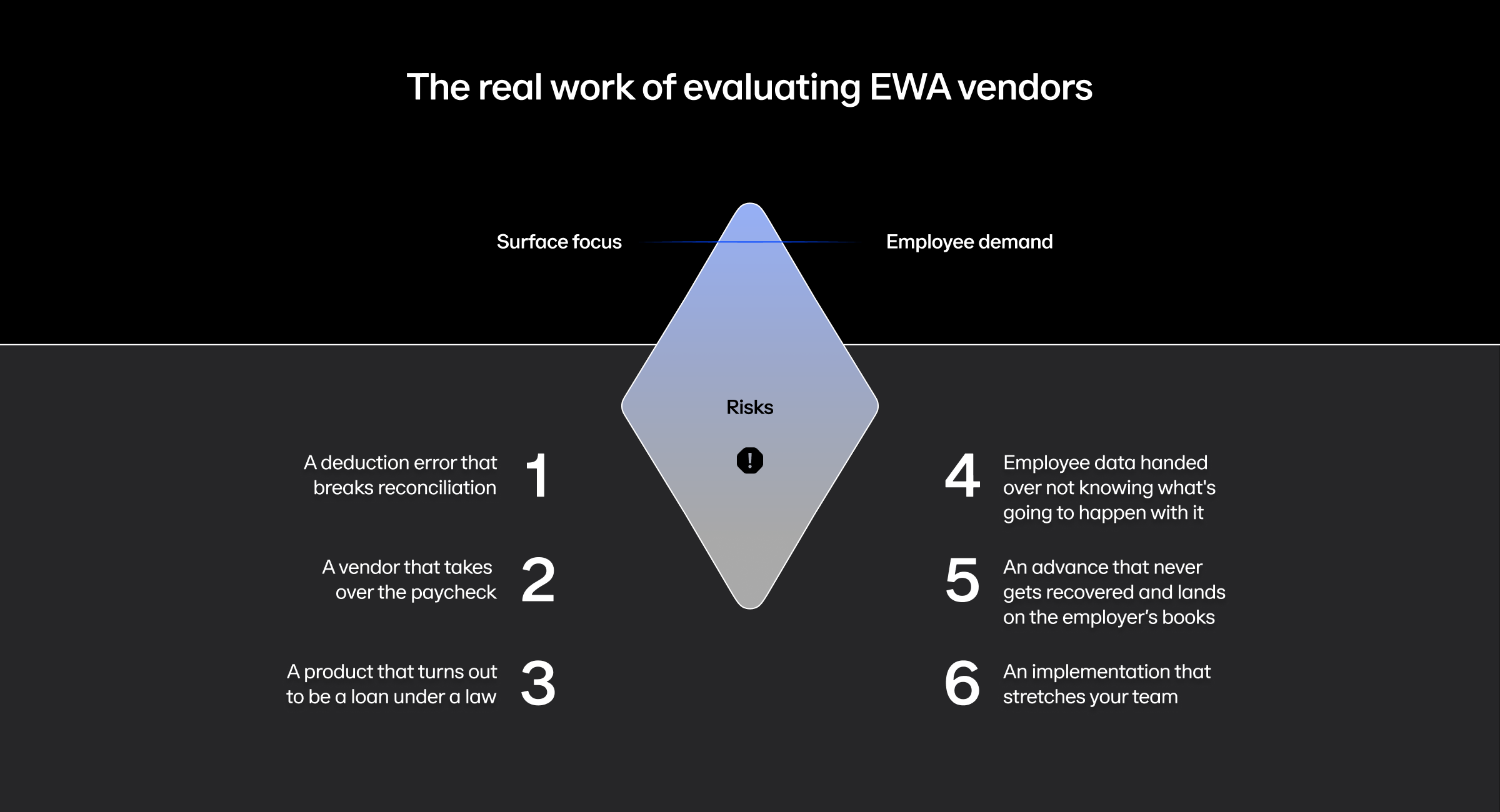
There's a structural reason payroll leaders are now in the room for these decisions. The right implementation model runs through payroll, and the wrong one creates problems that eventually land back on your team.
Settlement-model EWA, or D2C credit EWA, where the provider advances funds and auto-deducts repayment from the next direct deposit into the employee’s account, removes payroll from the equation. Forcing a primary bank change isn’t good for the employee’s financial health. Because it's D2C credit, loss rates are higher, so limits are lower which means users have access to a lower amount of their earned wages, another detriment to employee financial health.
With this model, there also isn’t any employer visibility into repayment. Collection attempts can continue after an employee leaves. Since repayment happens entirely outside the payroll system, there is the risk of overdraft and regulatory exposure in states with wage advance laws.
The payroll deduction model inverts this. Rain calculates available balances from your HCM and time and attendance data, the employee accesses what they need, and Rain automates payroll deductions relying on its seamless integrations with every major payroll system. You maintain full control. Repayment clears through normal payroll. Nothing bypasses your systems.
The reason this matters for a financial health platform evaluation, not just an EWA evaluation, is that the same logic compounds across every feature. A platform sitting outside payroll infrastructure is another vendor asking employees to change their direct deposit, open a new account, and trust a third party with their financial life. A platform integrated directly into payroll can offer personalized, data-informed guidance because it actually knows when the employee gets paid and how much.
Rain built the winning employer-integrated financial health infrastructure and we're uniquely positioned to deliver various differentiated financial health products. That's the foundation Rain is built on, and it's the foundation everything we're building next will sit on too. Free tax filing, AI-driven financial guidance, savings, credit building. None of it requires employees to switch banks or change their direct deposit, and none of it adds compliance exposure for the employer.
Three years ago, the payroll leader's job in an EWA evaluation was straightforward. Confirm the deduction model works, verify the integration, sign off.
Today you're being asked to evaluate whether a platform is truly helping your employees improve their financial health. That's a more complex question. It's also the right one. The 70% of frontline workers who report financial stress experience reduced stress with access to their earned wages. But access to earned wages alone isn’t enough.What they need is access to a comprehensive AI financial health platform that helps predict expenses and allows them to save so the next crisis doesn't wipe them out.
EWA gets employees to the table. Financial health keeps them there.
So when your next vendor sits across from you, ask one question. Will this platform know more about my employees' financial lives in 12 months than it does today, and will that knowledge actually help them? If the answer is no, you're being sold a feature, not infrastructure.
© 2026 Rain Technologies Inc.