

Most HR leaders know payday loans are bad for employees. But when team members are living paycheck to paycheck, the temptation to use them is real, and it does not disappear just because you offer direct deposit. What actually changes the equation is giving employees a better option before the crisis hits.
That is where earned wage access (EWA), also called on-demand pay, comes in. But the comparison between EWA and payday loans is worth understanding clearly, because they are not just different in degree. They are different in kind.
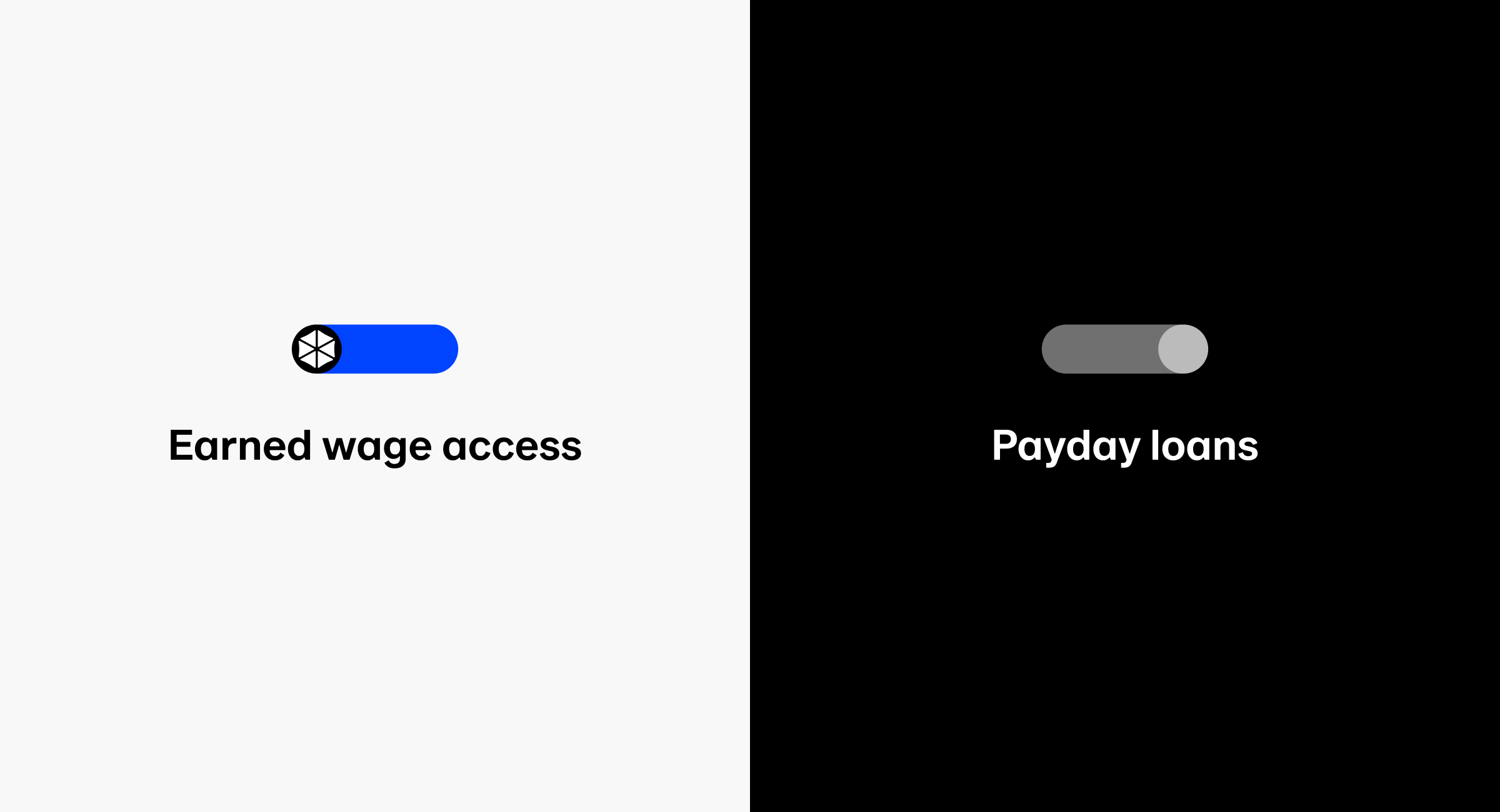
There is really nothing similar about earned wage access and payday loans. This side-by-side contrast shows how dissimilar they really are.
A payday loan is a short-term, high-cost loan typically due on the borrower's next payday. The structure sounds simple. The math is not. Most payday lenders charge $15 to $30 per $100 borrowed, which translates to an annual percentage rate of 300% to 400% or more. A worker who borrows $500 to cover rent can easily owe $575 or more within two weeks.
The cycle compounds quickly. Many borrowers cannot repay the full amount on payday and roll the loan over, adding another round of fees. According to the CFPB, a typical two-week payday loan carries an APR of nearly 400%. What started as a short-term fix becomes a months-long drain on take-home pay.
The cost is not just personal. When employees are trapped in payday debt cycles, financial stress does not stay at home. Research from CAPTRUST's 2026 Financial Wellness Survey found that 75% of employees say money worries affect their motivation at work, and 62% report moderate to severe financial stress influencing their productivity and physical health. That is not a personal problem. It’‘s a workforce problem.
Earned wage access gives employees the ability to access wages they have already earned before their scheduled payday. The key word is "earned." This is not a loan. There is no principal to repay with interest, no rollover fees, no debt trap. Employees are simply accessing money that is already theirs.
This distinction matters legally, practically and ethically. A November 2025 University of Oregon study cited in American Banker found that first-time EWA users saw their net monthly income increase by $334, an 11.5% gain, with no increases in overdraft fees, interest charges or other bank fees. Workers did not simply substitute one form of short-term borrowing for another. They came out financially better off.
The employer-integrated EWA model, like Rain where the product connects directly to payroll and timekeeping systems, is particularly different from direct-to-consumer cash advance apps. Because wages are calculated in near real time from actual hours worked, there is no guesswork about whether an employee has earned what they are accessing. Repayment happens automatically through payroll deduction at the end of the pay period. Employees never receive a zero paycheck, and employers retain full payroll control.
On-demand pay through an employer-integrated platform is also more protective than consumer payday advance apps, which operate outside the employer relationship entirely and often charge subscription or express transfer fees that erode the benefit.
HR and benefits leaders often think of financial wellness as a perk or a nice-to-have. But the data on how financial stress shows up at work makes it a business case issue.
Rain's 2026 "Closing the Pay Timing Gap" study found that 49.6% of hourly workers say waiting for pay hurts their focus or attendance. Nearly a quarter, 23.3%, said financial stress caused them to miss work or arrive late. And 37.3% had taken a second job just to access their pay faster, meaning employers were effectively competing with gig platforms for their own workforce's time and attention.
When employees turn to payday lenders to bridge the gap, the employer does not see the transaction. But they see the downstream effects: increased absenteeism, reduced productivity, higher turnover. Morgan Stanley's 2025 State of Workplace Financial Benefits Study found that 91% of HR leaders fear attrition will increase without better financial benefits, and 83% worry that employee financial stress is already hurting productivity.
The point is not just that payday loans are bad. The point is that the absence of a better alternative is something employers can actually fix.
Not all earned wage access products are built the same. When evaluating options, four criteria matter most:
Repayment model. Look for providers, like Rain, where repayment flows through payroll deduction before wages are disbursed. This protects both the employee and the employer because it eliminates collection risk, keeps payroll accurate and prevents workers from ever overdrawing what they have earned.
What happens after the access. A product that only solves for the immediate cash need without helping employees build long-term stability is not meaningfully different from a payday advance in its net effect. The best EWA platforms include tools for spending visibility, savings and financial guidance so workers can reduce their dependence on EWA over time, not increase it.
Cost structure. Zero-cost-to-employer models exist and are increasingly the standard for employer-sponsored EWA. If a vendor is asking employers to pay per transaction, ask who benefits from maximizing those transactions. Incentive alignment matters.
Integration footprint. A product that requires significant IT lift, custom payroll adjustments or ongoing HR administration is not a benefit, it's a burden. The right EWA partner should be able to onboard with minimal disruption and maintain that posture at scale.
The question for HR leaders is not whether employees are facing financial stress. CAPTRUST found that 85% of employees want employer-sponsored financial wellness resources, and access to those resources is strongly correlated with lower stress and better performance.
The question is whether your organization is going to be part of the solution or leave a vacuum that payday lenders are more than happy to fill.
Earned wage access does not eliminate financial stress on its own. But for employees caught between paychecks, it removes one of the most costly and damaging escape valves. And for employers, that translates directly into a more stable, more present, more productive workforce.
Request a demo to see how Rain's earned wage access and financial health platform works to improve your employees’ financial health.
What is the difference between earned wage access and a payday loan? Earned wage access (EWA) lets employees access wages they have already earned before their scheduled payday, with no interest, no fees from the employer and automatic repayment through payroll deduction. A payday loan is a short-term debt product that charges 300–400% APR, requires a lump-sum repayment on the next payday, and frequently traps borrowers in a rollover cycle. EWA is not a loan, it is access to money the employee has already earned.
Is earned wage access better than a payday loan? In virtually every measurable way, yes. EWA carries no interest, no rollover risk and no debt cycle. Research from a 2025 University of Oregon study found that first-time EWA users saw net monthly income increase by $334, without any increase in overdraft fees or bank charges. Payday advance products, by contrast, reduce take-home pay through fees and frequently worsen long-term financial stability. The distinction between EWA vs. payday advance is structural, not just a matter of degree.
What is on-demand pay and how does it compare to payday loans? On-demand pay, another term for earned wage access, is an employer-integrated benefit that allows employees to access accrued wages before payday through their existing payroll relationship. Unlike payday loans, on-demand pay is not a debt product, requires no credit check and carries no interest. Repayment is automatic through payroll deduction, so employees never take on new financial obligations. The comparison of on-demand pay vs. payday loan comes down to one fundamental difference: one is the employee's own money, the other is borrowed money with a high cost attached.
Does earned wage access cost employers anything? Leading employer-integrated EWA platforms, including Rain, are structured at zero cost to the employer. The product is funded through optional employee fees on transactions, which are typically minimal and far lower than the cost of a payday loan or overdraft fee. Employers gain the retention and engagement benefits without adding a line item to their benefits budget.
Why should HR leaders care about payday loan use among employees? Because the effects don't stay outside the workplace. Employees caught in payday debt cycles carry that financial stress into every shift, contributing to higher absenteeism, reduced productivity and elevated turnover. Morgan Stanley research found that 83% of HR executives already believe employee financial stress is hurting productivity. Payday loan dependency is one of the most acute drivers of that stress, and it's one that employer-sponsored EWA can directly address.
How do I evaluate earned wage access providers? The four criteria that matter most are:
Avoid platforms with per-transaction employer fees, as their incentive is to maximize usage rather than improve employee financial health.
© 2026 Rain Technologies Inc.