

Turnover is one of the most expensive workforce problems HR leaders face.
In hourly, frontline environments, where margins are tight and schedules are unforgiving, losing a worker doesn't just create a gap on the floor. It triggers a chain reaction: recruiting costs, overtime to cover shifts, productivity loss and the slow drain of institutional knowledge that goes with every exit.
Most research on what drives employees to leave points to the usual suspects: poor management, lack of growth opportunities, burnout. But there's a factor hiding in plain sight that doesn't get nearly the attention it deserves. Financial stress. Specifically, the timing of pay. Earned wage access, also called on-demand pay or real-time pay, is proving to be one of the most effective and underutilized tools for addressing that risk directly.
The link between financial stress and workforce instability is well-documented. According to the Valoir 2026 Employee Financial Wellness Report, employees spend an average of 3.3 hours per week dealing with personal finances at work, representing an 8% productivity loss that adds up to $1.1 trillion in annual employer costs. More than 20% say their job performance has been directly impacted by financial stress.
That stress doesn't stay contained to productivity metrics. It accelerates turnover in ways that are hard to trace back to a single cause. According to Rain's own research, 56.6% of hourly workers say they would stay with an employer longer if that employer offered faster pay access. Nearly 1 in 4 reported missing work or arriving late because of financial stress. That's not a personal failure. It's a structural problem created by the gap between when people earn their wages and when they can actually use them.
Most hourly workers in the U.S. are paid every two weeks. Bills, rent and emergencies don't wait for the calendar. When a worker's car breaks down three days before payday, they have a few options: a payday loan, an overdraft, a cash advance app or a second job. According to Rain's data, 37.3% of employees have taken a second job specifically to access pay faster. That's not ambition. That's desperation.
When employees take second jobs to smooth cash flow, their primary employer loses them in pieces before they leave entirely. Fewer available shifts, less engagement, more fatigue, lower quality work. The departure may not happen for months, but the process starts the day they sign up for a gig platform to bridge a gap their employer could have prevented.
The Morgan Stanley 2025 State of Workplace Financial Benefits Study found that 91% of HR leaders fear attrition will worsen if they don't improve financial benefits. That fear is grounded in real risk.
Employers who offer earned wage access consistently see measurable improvements in retention. Across Rain's employer base, clients see an average 35% reduction in turnover after implementing EWA. That's not a marginal improvement. In industries like health care, hospitality and manufacturing, where turnover costs can run $3,000 to $5,000 or more per employee depending on the role, a 35% reduction translates directly to the bottom line.
Rain's research also found that 66.2% of hourly workers say pay flexibility influences their job choice when evaluating offers. As earned wage access becomes more common, employers who don't offer it are actively disadvantaged in recruiting. Those who do are reporting up to 2x more applicants and higher offer acceptance rates.
The CAPTRUST 2026 Financial Wellness Survey reinforces the opportunity here. Seventy-five percent of employees say financial stress affects their motivation at work, and 85% say they want their employer to offer financial wellness resources. Employees are not just looking for higher wages. They are looking for employers who recognize financial health as part of the job.
One concern HR leaders raise about earned wage access is whether it creates a cycle of dependency or encourages overspending. The evidence doesn't support this. A 2025 University of Oregon study cited in American Banker found that first-time EWA users saw their net monthly income increase by $334, an 11.5% gain, with no corresponding increase in overdraft fees, interest charges or other bank fees. On-demand pay didn't pull people into more debt. It helped them escape the cash flow traps that were creating debt in the first place.
That distinction matters when making the case to finance or legal teams who may conflate EWA with payday lending. Employer-integrated earned wage access, where wages are advanced against hours already worked and repaid through a payroll deduction, is fundamentally different from a loan product. Employees aren't borrowing money they haven't earned. They're accessing wages they've already worked for, just ahead of the standard pay cycle.
For a long time, benefits leaders treated financial wellness as a personal responsibility issue. Offer some resources, a financial literacy course maybe, and let employees figure out the rest. That approach has largely failed. Adoption of passive financial wellness programs is low, and the employees who need help most are the least likely to seek it out through a webinar or a PDF.
What employers are learning is that financial health is a workforce issue, not just a personal one. When 1 in 4 employees miss work because of financial stress, that shows up in scheduling, productivity and ultimately retention. The employers who are seeing the biggest gains from earned wage access are the ones who treat it as an operational investment rather than a nice-to-have benefit.
The ROI math is straightforward. If you're turning over workers at a rate that costs millions of dollars a year, and a pay flexibility benefit that costs the employer nothing can reduce that turnover by a third, the question isn't whether you can afford to offer it. It's whether you can afford not to.
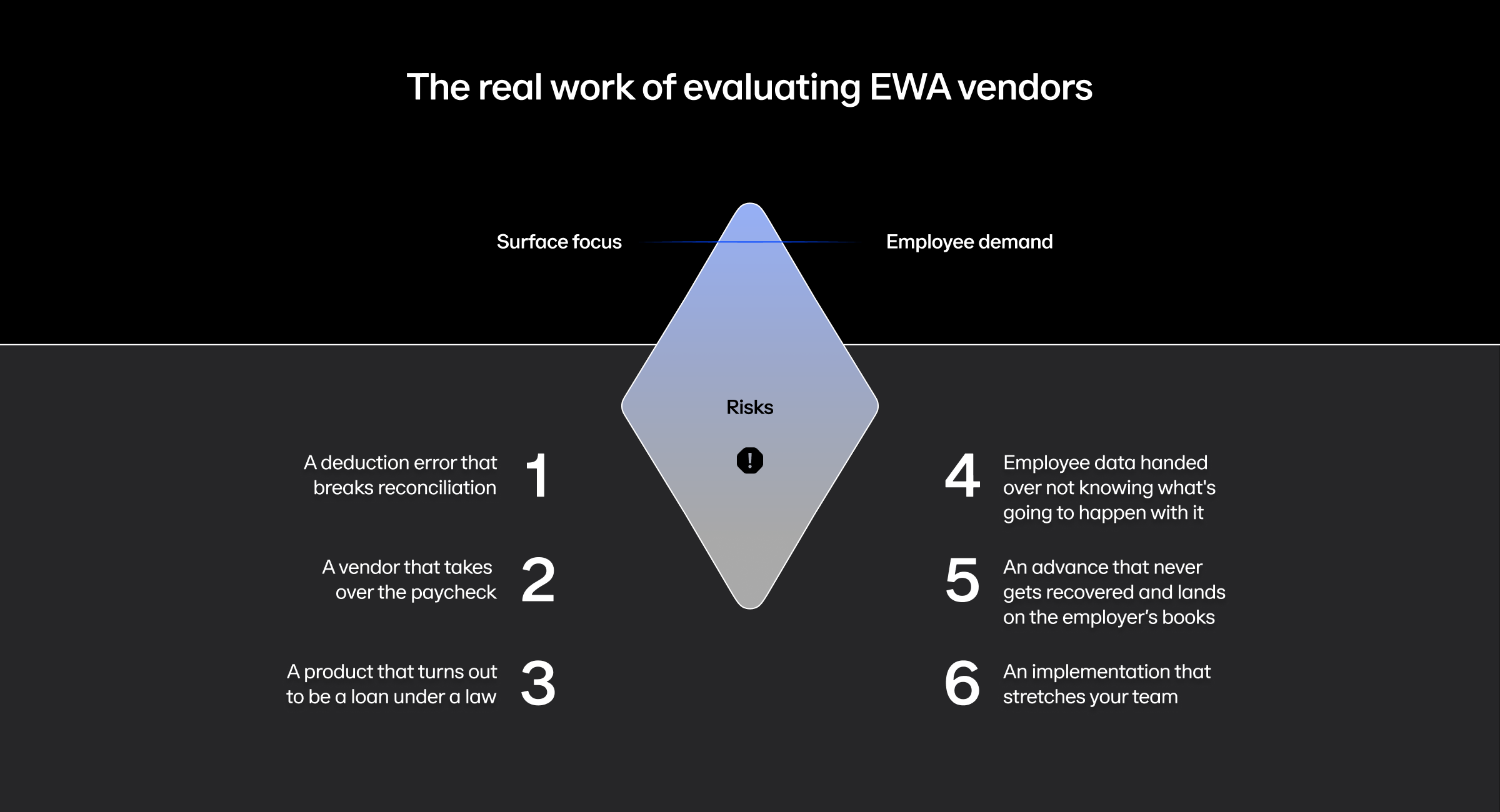
Not all earned wage access products are built the same. The core things to evaluate are payroll integration, cost structure and what happens beyond the EWA transaction.
On payroll integration, the right solution should be invisible to your payroll team. It should connect directly to your HCM and timekeeping systems to calculate earned wages in real time, and deliver payroll deductions back before payroll runs. Employees should see a single deduction line item on their pay stub, and their bank deposit should always match expectations. Zero-disruption implementation is not a nice-to-have. It's the baseline.
On cost, the best employer-integrated EWA models carry no cost to the employer. Employees pay a small instant transfer fee or receive funds free via ACH. There is no ongoing charge to the business, no subscription, no per-employee fee.
On what happens beyond the transaction, real-time pay access embedded in a broader financial health platform delivers more durable retention outcomes than EWA alone. When employees can access wages, build savings, manage spending and avoid predatory fees all in one place, the financial stress that drives disengagement and exits gets addressed at the root, not just patched over.
Turnover has many causes. But the financial stress created by pay timing gaps is one of the most preventable. Employees who have access to their earned wages when they need them show up more consistently, stay longer and are less likely to take second jobs that split their attention and availability.
The case for real-time pay access isn't just about being a good employer, though it is that. It's about removing a structural obstacle that's quietly draining your workforce. For frontline employers dealing with persistent turnover pressure, earned wage access is one of the highest-leverage investments available.
If you're evaluating earned wage access or looking to strengthen your financial health benefits strategy, see how Rain works for employers.
Does earned wage access actually reduce employee turnover?
Yes, and the data is consistent. Across Rain's employer base, clients see an average 35% reduction in turnover after implementing earned wage access. The mechanism is straightforward: when employees can access pay they've already earned without waiting for the next pay cycle, the financial pressure that leads to absenteeism, second jobs and ultimately exits gets reduced. Rain's research found that 56.6% of hourly workers say they would stay with an employer longer if that employer offered faster pay access.
What is on-demand pay and how does it work?
On-demand pay, also called earned wage access or real-time pay, gives employees access to wages they've already earned before the standard payday. In an employer-integrated model, the platform connects directly to the company's HCM and timekeeping systems, calculates earned wages in real time and allows employees to transfer funds instantly or via ACH at no cost. At the end of the pay cycle, repayment happens automatically through a payroll deduction. Employers see a single deduction line item with no changes to their payroll process.
Is earned wage access free for employers?
In most employer-integrated models, yes. Employees pay a small fee for instant transfers or receive funds free via next-day ACH. There is no per-employee charge, subscription fee or implementation cost to the employer. Rain's model is zero cost to the employer with no disruption to existing payroll operations.
Is earned wage access the same as a payday loan?
No. Earned wage access gives employees access to wages they have already worked for. There is no interest, no debt and no loan being issued. A 2025 University of Oregon study cited in American Banker found that first-time EWA users saw their net monthly income increase by $334 with no increase in overdraft fees or interest charges. Earned wage access helps employees escape the cash flow traps that lead to high-cost borrowing. It does not create new ones.
What should HR leaders look for when evaluating a real-time pay solution?
Three things matter most. First, payroll integration: the solution should connect directly to your existing HCM and timekeeping systems with no manual reconciliation and no changes to how payroll runs. Second, cost structure: the best models carry zero cost to the employer. Third, what the platform does beyond the transaction. Standalone EWA addresses the immediate cash flow gap. An earned wage access solution embedded in a broader financial health platform, with tools for savings, spending management and credit building, addresses the underlying financial stress that drives turnover in the first place.
© 2026 Rain Technologies Inc.