

These are fair questions, and almost none of them are actually about earned wage access. They are about how a specific provider moves the money.
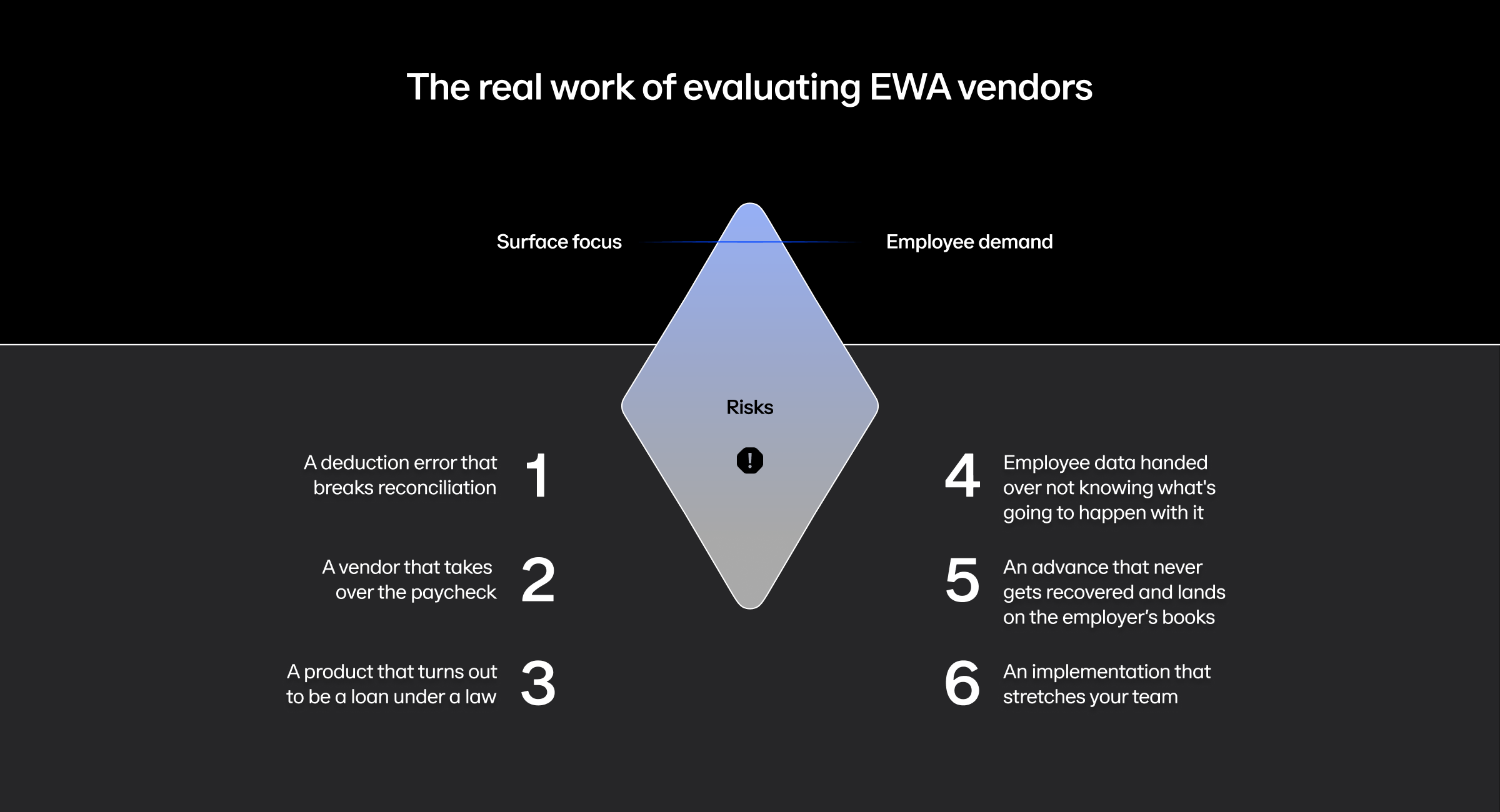
Evaluating earned wage access has nothing to do with whether employees want or need it. The real work is checking six specific risks in how the money actually moves:
Every one of these risks is worth checking, but none of them is inherent to earned wage access itself. They are consequences of how a specific provider moves money, and that is what a sound vendor evaluation should focus on.
This is usually the first thing payroll checks, and it is the right place to start. A team that has spent years getting a pay run to tie out exactly does not want a new variable it cannot audit sitting inside that process.
In a payroll deduction model, the provider calculates earned wages from the employer’s own HCM and time and attendance data, sends the employee an advance directly, then submits one deduction file that gets imported before payroll runs. Nothing else about the pay run changes. Taxes, garnishments and benefit deductions process exactly as they always have, and the employee sees a single line item that matches the deposit in their bank account down to the cent.
On Rain’s platform specifically, more than 99% of advances get recovered cleanly through that deduction file, and a pre-payroll confirmation step is built to catch a mismatch before the run goes out, not after.
This is the question that separates providers, and it is worth asking directly upfront.
Not every EWA model works the way described above. Some providers reroute an employee’s direct deposit entirely, so it lands in an account the provider controls. On payday, the provider is paid first, deducts what it is owed, and pushes the remainder to the employee, which means the employer is no longer technically the one paying its own people. That structure showed its downside in November 2023, when a technical issue left workers at a major takeover-model provider unable to access wages they believed were available, prompting the provider to cover the shortfall out of its own funds while the problem was fixed (Payments Dive).
Rain’s deduction model does not carry that dependency. Direct deposit is never touched, and the employer stays the payer of record regardless of what happens on the vendor’s servers.
Ask a provider directly whether an employee’s direct deposit changes to use the product. If the answer is yes, the risk profile is different from what most payroll teams expect.
Scrutiny here keeps growing, and payroll teams are right to want a straight answer.
Earned wage access sits in a genuinely unsettled regulatory space. As of early 2026, roughly a dozen states have passed EWA-specific licensing or disclosure laws, and the requirements differ meaningfully from state to state (Thomson Reuters).
At the federal level, the Consumer Financial Protection Bureau (CFPB) issued an advisory opinion in December 2025 stating that products meeting its definition of Covered EWA are not credit under the Truth in Lending Act. To qualify, a product must let workers access only wages already earned, recover the advance solely through an employer-facilitated payroll deduction with no other recourse against the employee, skip credit checks, and avoid reporting repayment activity to credit bureaus (Federal Register). That is a close description of the deduction model, and a meaningful distinction from a provider whose product behaves more like a short-term loan. It is also not the final word.
New York’s attorney general sued two EWA providers in April 2025 over allegations that their products functioned as disguised high-interest loans, and the case was still working through motions to dismiss more than a year later (Payments Dive).
Payroll and legal teams should ask any provider how its product maps to the CFPB’s Covered EWA criteria and how it is licensed in every state where the workforce is concentrated, particularly New York, which has its own pending legislation.
Every EWA integration means handing a vendor some amount of employee information, and the size of that handoff varies enormously by provider.
Some products require a Social Security number, date of birth or full banking credentials to enroll an employee. Others need only a name, phone number, email and home address. The difference matters because it defines the blast radius if something goes wrong, and something has gone wrong recently in this exact corner of the HR tech supply chain. One EWA and financial wellness provider disclosed a breach that exposed the names and Social Security numbers of more than 176,000 people, with the intrusion running from April to August 2025 and notifications not going out until late September (Claim Depot).
Before signing with any provider, payroll should get a straight answer on exactly which data fields are required, whether the provider is SOC 2 or ISO 27001 certified, and what its breach history looks like. Fewer required fields is a real security control, not a checkbox, since it shrinks the blast radius when something eventually goes wrong.
Who absorbs the cost if an advance is not recovered?
This is a question finance asks even when Payroll does not. A responsible EWA provider funds the advance itself, out of its own balance sheet, and only bills the employer for amounts it actually and successfully withholds through payroll, never as a blanket guarantee against a shortfall.
Rain funds 100% of every transaction with no pre-funding requirement or balance sheet liability for the employer, and reimbursement is limited to what is successfully withheld (Rain internal data). If a provider’s contract asks the employer to guarantee or pre-fund advances, that is worth flagging to finance before signing, since it shifts credit risk onto the employer’s books in a way the deduction model was built to avoid.
A common, quieter consideration is operational rather than financial. Will this generate a flood of calls asking why a paycheck looks smaller?
The answer depends entirely on transparency at the pay stub level. When the deduction shows up as one clearly labeled line item and the deposit matches it exactly, most employees never need to ask.
When a provider intercepts the whole paycheck and pays out a remainder with no clear line item, confusion and support tickets tend to follow, since employees have no easy way to see what was withheld and why.
Payroll teams often assume a new benefit like this means months of IT work layered onto an already full plate.
In practice, the technical setup for a deduction model typically runs two to four weeks. The provider connects to the employer’s existing HCM and time and attendance systems through an API or SFTP feed, wage thresholds and payment cutoffs get configured, and data gets validated before go-live. No new employee bank account is required, direct deposit does not change, and the existing payroll process runs exactly as it did before the vendor was added.
Every risk above turns into a specific question worth asking any EWA provider you’re considering before implementation:
These questions are the same due diligence payroll already applies to any vendor that touches a paycheck, and a provider built on a payroll deduction model should be able to answer all five without hesitation.
© 2026 Rain Technologies Inc.